
What is GEO

List of content
- GEO
- Importance of GEO
- Difference between SEO vs GEO
- Strategies of GEO
- Best practices of GEO
- Benefits of GEO
- Conclusion
Generative Engine Optimization GEO Marketing is the future of digital marketing! While traditional SEO efforts primarily focus on ranking links in search engine results, GEO is the process of positioning your brand as a trusted cause within the answers generated by AI platforms such as ChatGPT, Perplexity, and Google AI Impression. By optimizing content for AI-driven search experiences, GEO helps grow your brand’s visibility, credibility, and influence in the era of generative AI.

Importance of GEO
Imagine that in the past, whenever someone needed information, they would search on Google, open numerous websites, and then find the information they were looking for. Today, this situation is changing rapidly. People are nowadays asking questions directly to AI tools such as ChatGPT, Perplexity, and Google AI Overview and receiving concise answers instantly. This is where the role of Generative Engine Optimization (GEO) begins.

GEO is important because it ensures that when an AI generates an answer to a user’s question, it recognizes and references your brand, website, or content as a trustworthy source. If your content is not included among the sources used by AI systems, you could miss out on potential customers—even if your website ranks well in traditional SEO results.
Difference between GEO vs SEO
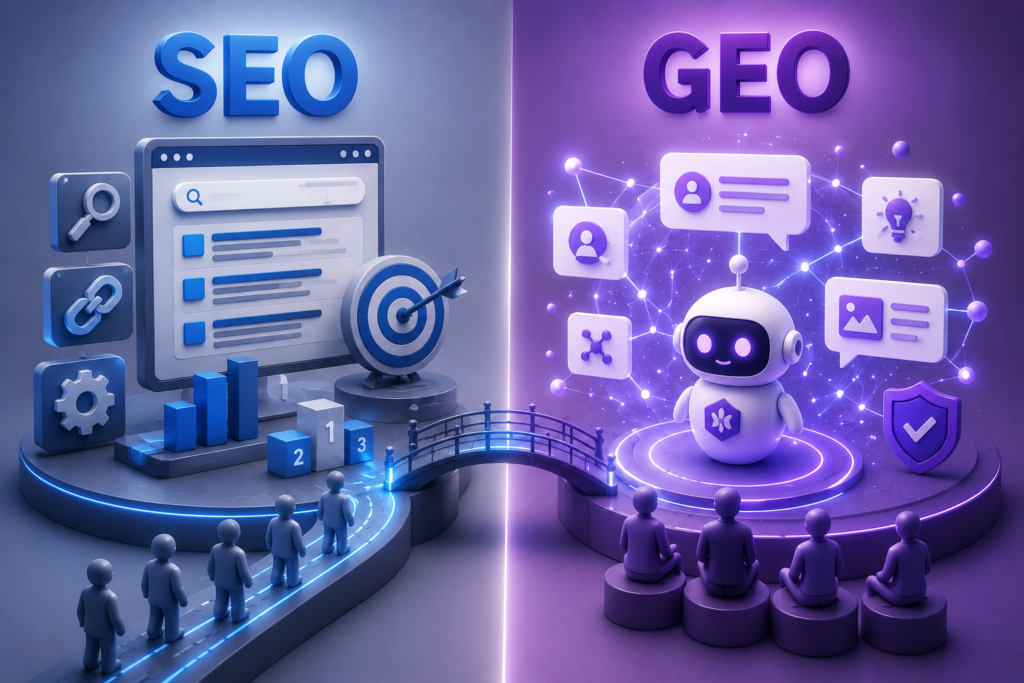
SEO (Search Engine Optimization)
Objective: The major goal of SEO is to improve a website’s ranking in search engine results pages (SERPs).
| Focus: SEO mostly emphasizes keyword optimization, backlink building, technical SEO, and search rankings. User Experience: In SEO, users typically click on search results and appointment websites to find information. Success Metrics: SEO performance is measured by organic traffic, click-through rates (CTR), keyword rankings, and SERP visibility. Platforms: SEO is optimized for outmoded search engines such as Google, Bing, etc. |
GEO (Generative Engine Optimization)
Objective: The principal goal of GEO is to ensure that a brand or its content is referenced and included in AI-gen responses.
| Focus: GEO emphasizes content quality, contextual relevance, credibility, specialization, and AI comprehension. User Experience: In GEO, users receive the shortest answers from AI platforms, often without needing to visit a website. Success Metrics: GEO performance is restrained through AI citations, brand mentions, source references, and visibility within AI-generated answers. Platforms: GEO is optimized and intended for AI-powered platforms such as ChatGPT, Perplexity, and Gemini. |
Strategies of GEO
As AI-powered search and answer-generation platforms continue to gain popularity, Generative Engine Optimization (GEO) is becoming an essential strategy for businesses and content creators. Below are two of the most significant GEO strategies:
Create High-Quality and Trustworthy Content
AI platforms prioritize sources that provide accurate, up-to-date, and dependable information. Therefore, your content should be accurate, research-driven, and focused on addressing user needs. High-quality content not only improves credibility but also increases the probability of being referenced in AI-generated responses

Develop Question-Based Content

Users increasingly interact with AI platforms by asking traditional questions. As a result, content should be structured around mutual user queries and provide clear, concise, and informative answers. This format helps AI systems better understand and extract pertinent information from your content.
Best practices of GEO
With the mounting adoption of AI-powered search and answer-generation platforms, generative engine optimization (GEO) has become a dangerous strategy for businesses and content creators. The following best practices can help confirm that your content is effectively understood, referenced, and cited by AI platforms.
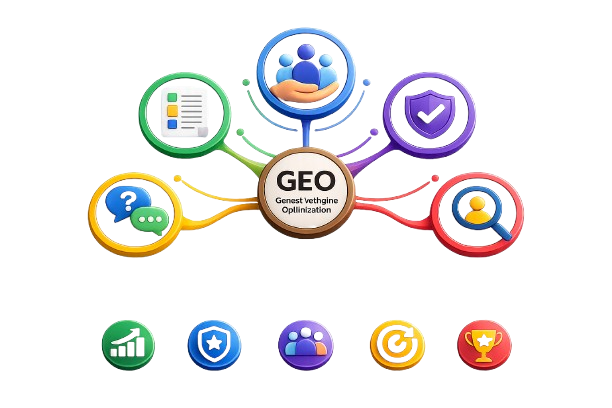
- Generate User-Centric and Valuable Content
- Use a Vibrant and Well-Structured Format
- Provide Consistent and Fact-Based Information
- Adopt a Question-and-Answer Format
- Track the E-E-A-T Framework
Benefits of GEO
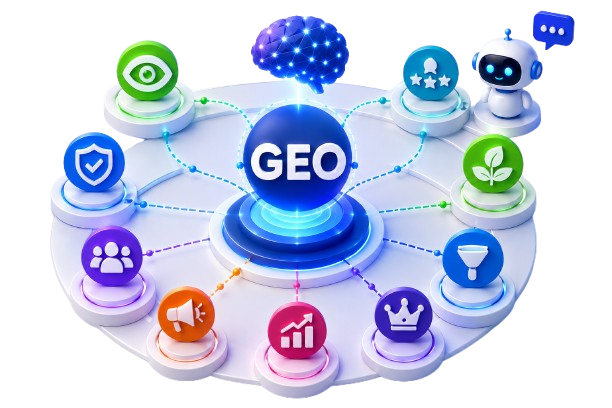
As AI-powered search and answer-generation platforms continue to improve in popularity, Generative Engine Optimization (GEO) is becoming an essential strategy for businesses, brands, and content creators. Implementing GEO can afford several significant advantages.
- Increased Visibility Across AI-Powered Platforms
- Enhanced Brand Credibility and Authority
- Access to a Highly Relevant Audience
- Competitive Advantage
- Improved Content Quality
Also read abour AI in smart gadgets.
Conclusion

Generative Engine Optimization (GEO) is an emerging, future-focused digital marketing tactic that enables businesses and content creators to realize greater visibility, credibility, and influence across AI-powered platforms. While traditional SEO focuses on improving rankings in search engine results, GEO aims to position brands and content as trusted sources within AI-generated responses. By emphasizing high-quality content, rich structure, reliable information, topical expertise, and a user-centric approach, GEO helps organizations enhance brand awareness, reach highly pertinent audiences, and gain a competitive advantage. As AI-driven search and information discovery continue to evolve, GEO is becoming an essential component of digital marketing, helping businesses protect long-term growth, strengthen their online presence, and remain competitive in the rapidly changing digital landscape.