What is Computer Network? Types, Advantages, Disadvantages & Uses

In this Article, I am going to explain What is Computer Network? So, A computer network is an assembly of linked devices that exchanges resources and information together. It is providing supports of File Sharing, Emails and Internet browsing and play games and also use AI like chat GPT and GEMINI as well as communication.
Table of Contents
A network can connect through wired links, such as Ethernet or fiber-optic cables, or wireless signals, such as Wi-Fi or cellular network. The networked devices follow communication protocols that define how to transmit or exchange data across a network. The main purpose of a network is to make communication and information sharing faster, easier, and more efficient.
Development of Network or Networking
As we know, in the late 1960s the development of computer network started. In 1961, the United States of Department of Defense supported the early development of computer through a project called ARPANET (Advanced Research Projects Agency Network). In 1969, the first packet-switched computer network and today’s public internet ARPANET was first used. Later that year, ARPANET adopted TCP/IP protocols. The first communication between UCLA and SRI took place on October 29, 1969.
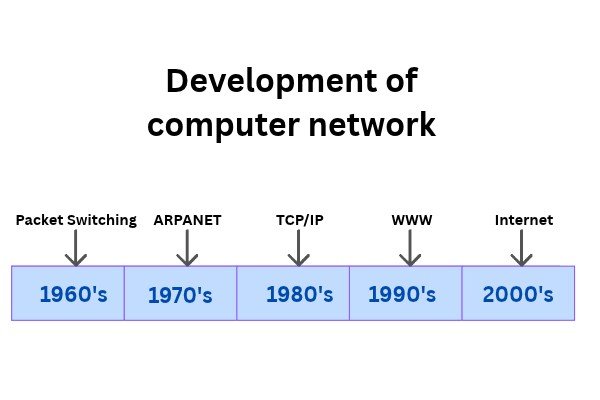
As the internet became increasingly commercialized, many networks sprang up worldwide. Each network uses separate protocols for communicating over the network. As a result, joining multiple networks smoothly becomes impossible. So, Tim Berners-Lee led a team of computer scientists and proposed the World Wide Web (WWW) in 1989, a seamless network of various networks. However, these networks were unable to communicate with each other. So, in 1977, TCP/IP was developed on ARPANET to enable communication between different networks.
How does a computer network work?
When we search on browsers or open a website, multiple steps occur within a millisecond. These actions are implemented with the help of hardware devices, software programs, cable connection, wireless signals, communication network protocols.
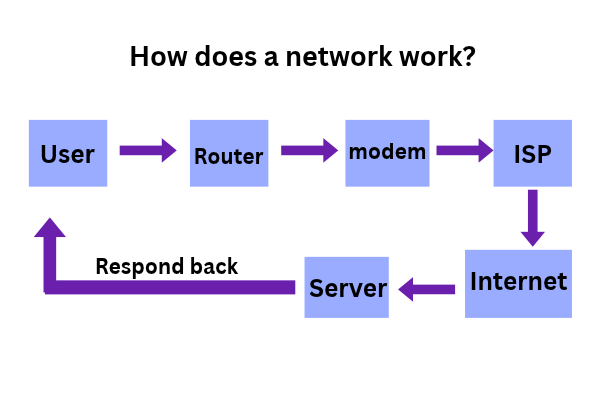
Here is the step-by-step process of working of computer network:
- You open a browser and enter a website address (like ://google.com) or search any query.
- Your device contacts a Domain Name System (DNS) to find exact IP address of the website’s domain name.
- Your device then establishes a reliable connection and sends request through Internet Service Provider (ISP).
- Your request travels through different networks and routers to reach the destination server.
- Then the server processes the request and sends the required information back.
- The browser receives the information and displays the website on your device.
Important Components of Network
There are several components of a computer network that assists in its working and helps the devices to connect and share data and information with each other easily.
Some of the most common components are:
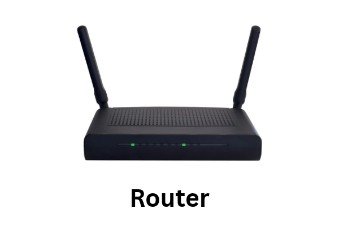
- Router: A router is a device which helps us to connect multiple devices to a network and forwards data packets using routing routing protocols to determine best path for each data based on their destination using IP address.
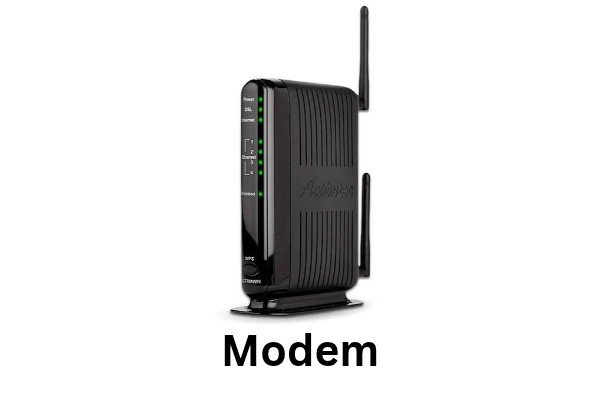
- Modem: A modem is a device that converts digital signals originating from a computer network into analog signals like telephone or cable lines. It is used to connect a home network or a router to the Internet Service Provider (ISP).
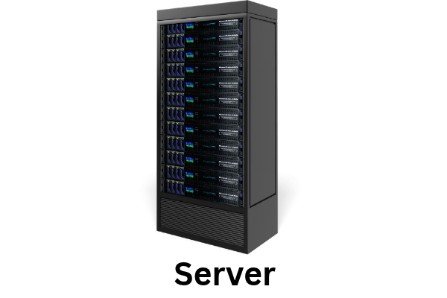
- Server: A server is a hardware device or a software program that provides data and services to other devices known as clients through the network. These services include data and resource sharing between multiple clients. It operates on request response model.
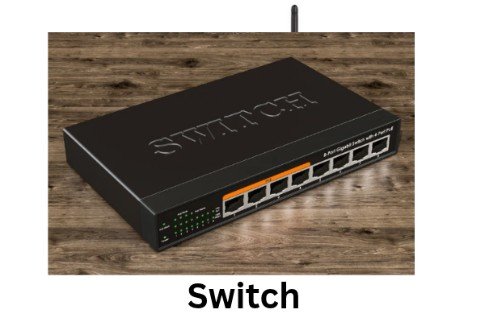
- Switch: A switch is used to transmit data between one node to another inside a network. It an intelligent device that uses MAC addresses to identify the source and designation of data packets and sends only to the intended recipient.
Do you want to read about computer Shortcuts? click here to read
Type of Computer Networks
Here we will discuss about Types of Computer networks are mainly categorized by the geographical coverage, as well as their specific purpose.
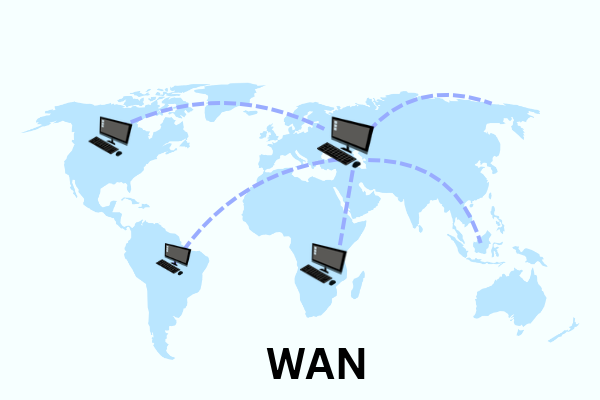
- WAN (Wide Area Network): WAN covers extensive geographical areas like states, countries, or the entire globe (such as the Internet) and connects multiple smaller networks such as LAN MAN and WAN via satellites, or leased phone lines.
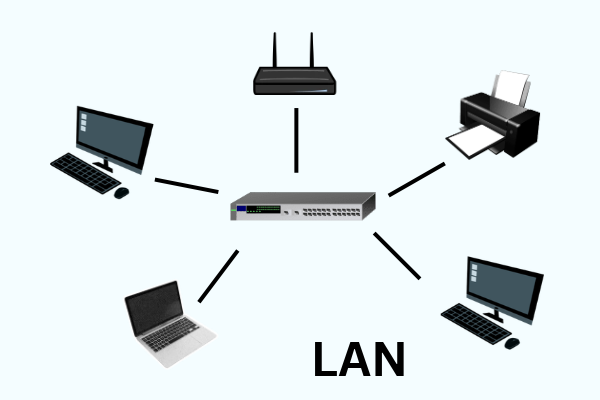
- LAN (Local Area Network): LAN covers a small geographic area, such as a home, office, or a school building. It offers high-speed data transfer. It covers a range of approx. 25 to 100 meters.
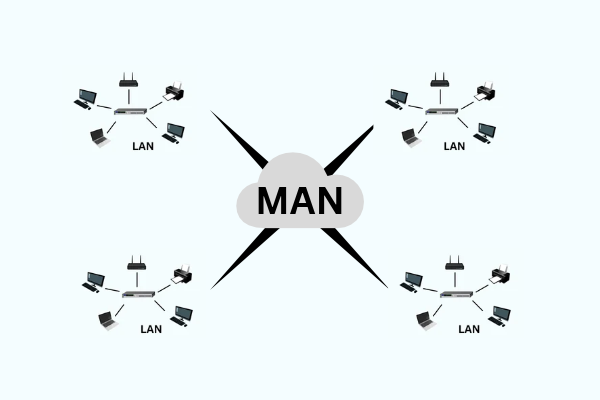
- MAN (Metropolitan Area Network): A MAN spans a range of a large campus to a whole city, by connecting multiple LANs within the geographical area. MANs often use high-speed technologies like fiber optics and protocols. It covers an area from 5 to 50 km range.
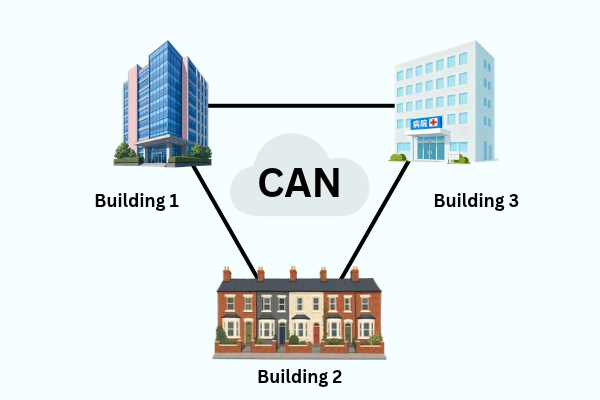
- CAN (Campus Area Network): A CAN spans an area covering multiple buildings within a campus. It is larger in area than a LAN but smaller than a MAN, with a high-speed communication. It covers an area within 1-5 km range.
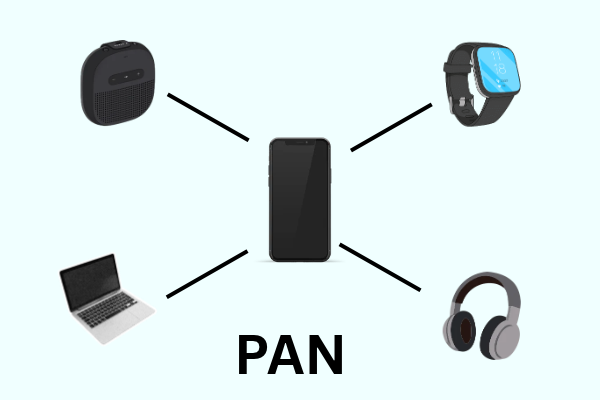
- PAN (Personal Area Network): Now a days, people are installing a broadband at home small offices to work on internet, that is called a PAN network. It is a small network that will covers a very small range (approx. less than 10-15 meters) around an individual area, by connecting personal devices like smartphones, computers, and laptops using Bluetooth, USB, or Wi-Fi directly.
Applications
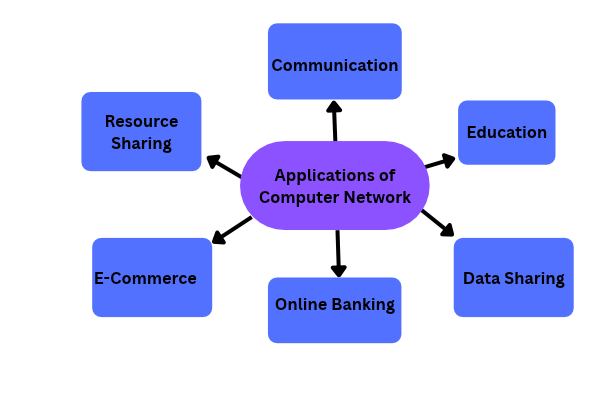
It plays an important role in our everyday life. It is used for the transmission of data faster between more computer networks. Many people explore and have unlimited access to the available information and resources on the network, they can also interact and engage with other people across the network, and conducts their businesses speedily. Organizations such as businesses, educational institutions, and everyday users’ views computer network as place which they can use for communication and resource accessing and sharing.
Now learn about Advantages and disadvantages of Network.
Advantages of Computer Network
It offers many benefits that makes our lives easier and more convenient.
- Multiple users can share files, data, devices (such as printers, scanners), and internet connections with each other.
- People can communicate and share messages in real time via email, chat and video tools.
- We can store data on file server, so that we can make backup easily and improves reliability.
- Users can access network files and log in from various places, facilitating remote and hybrid work settings.
Dis-Advantages
Although computer network has many advantages, it also has disadvantages.
- Using network without proper security and protection we may face unauthorized access, data theft and cyberattacks by hackers.
- The setup and maintenance cost for network cables and servers are expensive.
- Excessive use of computer network can affect our studies, work performance, sleep, and daily activities.
- Spending too much time on screens causes our eyes to wear out and keeps us less active.
Conclusion
In this article, we have covered the about computer network and its development, how it works and some of its important components. Then, we explained various types of networks, advantages and disadvantages of computer network and its applications.